RSS

HUB Cycling has launched their “Bike to Shop” campaign this month to encourage more residents to use two wheels instead of four

This August is Bike to Shop month, an initiative run by HUB Cycling. Photo via HUB Cycling.

Lisa Storey is a committed cyclist, and she uses her bike to shop. She finds that it saves time and money. But she admits that she hasn’t always found it convenient.

“It me took me a wee while to get the confidence to do it myself,” she said. 

There was some trial and error, she says. At first, Storey loaded her entire grocery hauls into the front basket. Then the basket broke, and its contents were thrown onto the street.

But now Storey has her system  — she always keeps a bungee cord on her bike rack and distributes groceries across the frame.

As the event manager of HUB Cycling, a Metro Vancouver cycling non-profit, she’s spent this month trying to encourage Metro Vancouver to also start using two wheels to shop.

This is part of the charity’s Bike to Shop initiative. It has several neighbourhoods participating, including Coquitlam’s Austin Heights and Central Port Moody.

“We’re just asking people to give it a try,” Storey said.

She encourages interested participants to take a pledge to give shopping by bike a shot at least once. Then, they will be eligible to win prizes (including Cirque Du Soleil tickets).

Storey said they are educating folks on common barriers that prevent folks from biking, including finding safe routes, bike theft and how to carry items on one’s bike.

“That’s the idea behind it, really, is just to show people that shopping by bike isn’t that scary.”

HUB Cycling created a number of neighbourhood maps — including a Tri-Cities map — that shows bike routes, bike parking locations and some of their partners and suggested businesses to visit.

The routes are labeled by comfort level — comfortable for most, comfortable for few, comfortable for some and comfortable for very few — to help people plan their trip

They’ve included businesses in their initiative to let them know that “cyclists are good for businesses.” 

People on bikes tend to stop more frequently than drivers do while spending similar amounts of money, Storey said. They also require substantially less parking space.

As for bike theft, Storey acknowledges that it is an unfortunate part of cycling, but says they are educating people on how to properly lock up their bikes and informing them about any bike valets or bike lockers — such as Translink. People can also register their bikes for free with Project 529 (when registered bikes are stolen, a large network is informed and keeps their eye out for it). 

Overall, Storey advises folks to start small.

“And all of a sudden, before you know it, once you’ve built that confidence, you’ll be doing those longer journeys.”

The campaign runs until August 31. 

https://tricitiesdispatch.com/local-charity-encourages-tri-cities-to-bike/

Read

From left to right: Coquitlam–Port Coquitlam MP Ron McKinnon, Kwikwetlem First Nation Coun. John Peters, Coquitlam Mayor Richard Stewart, and Port Moody MLA Rick Glumac following the announcement at at ƛ̓éxətəm Regional Park. Patrick Penner photo

A $19.9 million funding package has been announced to improve the diking systems along the lower Coquitlam River and Fraser River.

Coquitlam Mayor Richard Stewart, Kwikwetlem First Nation Coun. John Peters, Coquitlam–Port Coquitlam MP Ron McKinnon, and Port Moody MLA Rick Glumac announced the joint investment on Aug. 15 at ƛ̓ éxətəm Regional Park, formerly known as Colony Farm Regional Park.

Stewart said the local governments and First Nations are the “front lines’ with respect to climate change, as seen through recent flooding events across the province.

“Our collective action in planning and preparing for flood events underscores our shared commitment to safeguarding our communities and reducing the risks they face,” Stewart said.

Rising water levels and increased rainfall from climate change are increasing the flood risk to Kwikwetlem’s slakəyánc community, the regional transportation network, Mayfair Industrial Park in Coquitlam and ƛ̓éxətəm Regional Park, states a new release from the federal government.

The funding will allow the City of Coquitlam and Kwikwetlem First Nation to upgrade the area’s current flood-protection network by building enhanced dikes. In addition, fish habitats will be strengthened and new flood boxes will be installed to support water connectivity through the dike and local drainage system, preventing backflow.

Peters said that slakəyánc has faced significant flood risks for years, and the upgrading of critical flood-protection infrastructure will help protect the community in the future.

“Investing in climate adaptation is crucial to safeguarding our people and the lands we have cared for since time immemorial,” Peters said. “Together, we are building a safer and more resilient future for everyone.”

The community of slakəyánc was left unprotected by diking infrastructure built in the early 20th century to protect Colony Farm Regional Park. 

slakəyánc has flooded at least 21 times from winter and freshet flooding on the Coquitlam and Fraser rivers since 1909, states a news release from the Kwikwetlem First Nation, adding it remains at constant risk to this day.

“Flooding in our community has been a serious issue for several decades now due to rising levels of water from the Coquitlam Lake Watershed, diking and increased rainfall caused by climate change,” said Coun. George Chaffee of the Kwikwetlem First Nation. “With this funding and the substantial improvements that will result from this project, we are working with our regional partners to ensure that these historical wrongs are finally addressed.”

A total of $11,487,350 is being drawn from the federal government’s Green Infrastructure Stream of the Investing in Canada Infrastructure Program, which aims to help communities prepare for climate change, reduce emissions and support renewable technologies.

Over 125 infrastructure projects in B.C. have been announced under the Green Infrastructure Stream, amounting to more than $555 million in federal funds and more than $390 million in provincial funds.

The province is contributing $4,827,684 towards the project, while Kwikwetlem First Nation and Coquitlam are contributing $992,966 and $2,670,000, respectively.

The Kwikwetlem First Nation states the joint venture will help strengthen their relationship with the City of Coquitlam, and improve the slakəyánc community’s resilience by safeguarding and restoring sacred sites, local waterways and ecosystems.

A Kwikwetlem First Nation representative said they are aiming to start work on the project in 2027 and having it completed in 2029.

https://tricitiesdispatch.com/dike-funding-announcement/

Read

The six-storey, 173-unit development project on the 3000 block of Henry Street received a development permit from Port Moody in 2021, but remains undeveloped. Image supplied

[UPDATE: The Dispatch has updated this article with comments from Aultrust Financial.]

A major development project in Port Moody has defaulted on its loans and has been ordered into receivership, despite opposition from investors.

Bayrock Terrace is a six-storey, 173-unit development project approved for the 3000 block of Henry Street, just southeast of the Moody Centre SkyTrain Station, which received a development permit from Port Moody council in 2021.

On June 19, KingSett Mortgage Corporation filed a petition with B.C. Supreme Court to appoint a receiver over the four mortgaged properties, collectively valued at nearly $9.8 million according to BC Assessment. KingSett said they intend to sell off the lands and recoup $12.4 million loaned to developers.

The properties are jointly owned by 3000 Henry Street Limited Partnership, and its general manager, Aultrust Financial, through a B.C. holding company.

As the general partners of the development consortium, Aultrust’s co-founders, Amin Eskooch and Navid Morawej, personally guaranteed the loan, and were required to make monthly interest payments on the debt.

But starting on Feb. 1, 2024, the interest payments went unpaid, leading KingSett to demand the outstanding debt be paid back. Counting accrued interest, the debt has now grown to over $13.1 million. 

Aultrust did not attempt to fight the appointment of a receiver, and court approved KingSett’s petition on July 29.

Opposition from investors

Seven other investors in 3000 Henry Street Limited Partnership, however, opposed the appointment of the receiver. These investors hold a substantial majority of the units, and argued the receivership was “unnecessary and inappropriate.”

They said because the lands remain undeveloped, there is no maintenance or risk of damage to the properties; recent offers from sales efforts show that KingSett is well secured and not at risk; and a receivership would be a significant cost to unitholders, describing it as “wholly inequitable.”

“The unitholders ought to be afforded a chance to realize at least some return on their investment,” the investors said in their response to KingSett’s petition.

The investors requested a chance to pursue investments, refinancing or a sale, potentially through a foreclosure proceeding, and potential removal of Aultrust as their general manager.

It is not the first time that members of the consortium has tried to remove Eskooch and Morawej as the general partners. In fact, the opposing investors alleged the receivership proceedings began under “suspicious circumstances.”

“Navid and Amin may be attempting to utilize a receivership as a means of maintaining an interest in the lands while shedding themselves of the unitholders and avoiding any potential liability,” claimed the investors.

Aultrust Financial had been contracted by the 3000 Henry Street Limited Partnership in order to provide project development services in 2019.

The investors submitted the consortium became increasingly dissatisfied with Eskooch and Morawej’s marketing and sales efforts, with many believing they were pursuing transactions to benefit themselves personally through joint venture agreements, which would earn them fees.

In April 2023, the investors passed a resolution to remove Aultrust Financial as the managing partner, but the resolution was eventually withdrawn the following September due to concerns over meeting deadlines, and a potential costly litigation process.

The group stated they sought legal counsel after two opposing investors met with Jeremy Towning, director of acquisition for the Swissreal Properties.

Towning informed the investors that Eskooch and Morawej had entered into negotiations with Swissreal to bring in an equity partner to purchase the lands, according to the investors.

They claim that Towning advised them that a deal had been worked out, where an undisclosed equity partner had agreed to purchase the lands for $15.5 million, Eskooch and Morawej would become co-partners through their own company, and Kingsett would continue to be the lender.

The investors, however, claimed that offers of up to $30 million were received through previous sales efforts. They also note that Morawej recently became the director of operations for Swissreal, and Eskooch recently became its director of investment.

KingSett’s response

But KingSett responded the opposing investors have “no standing in the proceedings,” as Eskooch and Morawey were the guarantors of the loan through the holding company, adding as limited partners, the investors have not provided any security to KingSett in connection to the loan.

The 2017 limited partnership agreement with the consortium states that its general partner is soley responsible for an “any litigation involving a claim by or against (3000 Henry Street LP),” noted KingSett.

“KingSett has not named any of the opposing unit holders in its petition and is not seeking recourse against the opposing unit holders at this time.”

KingSett said that previous marketing efforts resulted in bids significantly below the appraised values, the opposing investors’ appraisals are outdated, and a number of permits are at risk of expiring if immediate steps are not taken.

The lender also argued that interest from their loan would continue to grow, and any delays would erode the equity the consortium holds in the properties.

KingSett argued the position of the general partner, which has agreed to the receivership, should be given significant weight over the opposing investors.

“It is the job of the general partner to develop this property, it has the understanding of the details and the value of the property and it is of the view that any undue delay will decrease the value of the property,” KingSett said.

The project will now likely undergo a court-supervised auction process.

Aultrust Financial’s response to opposing investors’ allegations

Eskooch said the project was on track to be brought to market earlier this year, but progress was derailed after opposing investors reneged on their financial obligations by refusing to put up more cash, which they were obligated to do under contractual conditions.

Aultrust intents to hold these investors accountable through “every legal meganism at our disposal,” he said.

“The ‘opposing investors’ saw it more convenient to simply breach their contract, than to continue to fund the project which although still profitable, had less than original number of anticipated profits due to rising costs and inflation,” Eskooch said.

Eskooch described the investors’ allegations as “smoke screen” to cover their default and breach of contract.” He said they were looking to quickly flip the properties after achieving rezoning.

Joint ventures were negotiated to reduce risk, provide financial backing, and maintain commitments with the city, “which the investors refused everytime,” Eskooch said, adding Aultrust fees were negligible and have gone unpaid to date.

KingSett waited six months for investors to change course, and commenced legal action independently of Aultrust, Eskooch said. He said any allegation of wrongdoing is “at best ignorance of the law and rather likely, an excuse to cover up their own breach of obligations.”

He said he and Morawey remain personally liable for the debt, and could suffer great personal damage as they relied on the wealth of these investors to fulfill their obligation to the lender and the city.

Eskooch said the project had less units than originally anticipated, and investors found the decreased profit unacceptable.

“We feel that investors who have in the good times, fully benefited from the community development and made large profits, must be held accountable for their failure to honor their obligations to the City vis a vis the developer, when they see the profits slightly reduced,” Eskooch said.

https://tricitiesdispatch.com/development-receivership/

Read

images supplied

Coquitlam put it forward and Coquitlam council approved it.

Following a rezoning and a subdivision, some Burke Mountain parcels are set to be turned into seven lots zoned for single-family houses, following a unanimous final approval vote from Coquitlam council Monday.

Located on a one-acre, city-owned parcel on the south side of Sheffield Avenue, the lots were previously zoned for agriculture and resource. Following approval of the application from Coquitlam’s real estate department, the parcel is set to be converted to residential and subdivided.

Discussing the application in February, one councillor asked why townhouses wouldn’t be a better fit.

The single-family houses should create a buffer between Burke Mountain’s older homes and the neighbourhood’s dense urban village, explained Coquitlam’s city lands and real estate department Curtis Scott.

The development is expected to generate approximately $461,000 for the city via community amenity contributions and development cost charges.

The lots are leftovers from a previous development immediately south that allowed for the creation of two lots slated for medium density apartments and three lots set for townhouses development.

The change spurred a somewhat contentious hearing with several residents arguing that medium density development would overwhelm infrastructure, obstruct views and snarl traffic.

Everyone who lives on Burke Mountain was once a newcomer to the area, Coun. Brent Asmundson said during the meeting.

“I’ve lived there for 32 years, longer than most of the people that spoke up here tonight about not wanting some other people to be up there,” Asmundson said. “I could have said a long time ago, ‘No, none of you guys come up here.’”

Coquitlam’s initial plan for Burke Mountain was a community consisting of about 2,000 units of housing and 120,000 square feet of commercial spread over 39 acres.

https://tricitiesdispatch.com/coquitlam-adds-seven-single-family-lots-to-burke-mountain/

Read

Newly listed properties registered on the Multiple Listing Service® (MLS®) rose nearly twenty per cent year over year in July, helping to sustain a healthy level of inventory in the Metro Vancouver1 housing market. 


On the demand side, the Greater Vancouver REALTORS®2 (GVR) reports that residential sales in the region totalled 2,333 in July 2024, a 5 per cent decrease from the 2,455 sales recorded in July 2023. This was 17.6 per cent below the 10-year seasonal average (2,831).


“The trend of buyers remaining hesitant, that began a few months ago, continued in the July data despite a fresh quarter percentage point cut to the Bank of Canada’s policy rate,” Andrew Lis, GVR’s director of economics and data analytics said. “With the recent half percentage point decline in the policy rate over the past few months, and with so much inventory to choose from, it’s a bit surprising transaction levels remain below historical norms as we enter the mid-point of summer.” 


There were 5,597 detached, attached and apartment properties newly listed for sale on the MLS® in Metro Vancouver in July 2024. This represents a 20.4 per cent increase compared to the 4,649 properties listed in July 2023. This was also 12.7 per cent above the 10-year seasonal average (4,968). 


The total number of properties currently listed for sale on the MLS® in Metro Vancouver is 14,326, a 39.1 per cent increase compared to July 2023 (10,301). This is also 21.5 per cent above the 10-year seasonal average (11,788). 


Across all detached, attached and apartment property types, the sales-to-active listings ratio for July 2024 is 16.9 per cent. By property type, the ratio is 12.8 per cent for detached homes, 20.1 per cent for attached, and 19.3 per cent for apartments. 


Analysis of the historical data suggests downward pressure on home prices occurs when the ratio dips below 12 per cent for a sustained period, while home prices often experience upward pressure when it surpasses 20 per cent over several months. 


“With the overall market experiencing balanced conditions, and with a healthy level of inventory not seen in quite a few years, price trends across all segments have leveled out with very modest declines occurring month over month,” Lis said. “While it remains to be seen whether softening prices and improved borrowing costs will entice buyers to purchase as we head into the fall market, it’s worth noting that it can take a few months for improvements to borrowing costs to materialize into higher transaction levels. In this respect, it’s still early days, so we will watch the market for signs of transaction activity picking up in the months ahead.” 


The MLS® Home Price Index composite benchmark price for all residential properties in Metro Vancouver is currently $1,197,700. This represents a 0.8 per cent decrease over July 2023 and a 0.8 per cent decrease compared to June 2024. 


Sales of detached homes in July 2024 reached 688, a 1 per cent increase from the 681 detached sales recorded in July 2023. The benchmark price for a detached home is $2,049,000. This represents a 2.1 per cent increase from July 2023 and a 0.6 per cent decrease compared to June 2024. 


Sales of apartment homes reached 1,192 in July 2024, a 6.9 per cent decrease compared to the 1,281 sales in July 2023. The benchmark price of an apartment home is $768,200. This represents a 0.3 per cent decrease from July 2023 and a 0.7 per cent decrease compared to June 2024. 


Attached home sales in July 2024 totalled 437, a 6.2 per cent decrease compared to the 466 sales in July 2023. The benchmark price of a townhouse is $1,124,700. This represents a 1.4 per cent increase from July 2023 and a 1.2 per cent decrease compared to June 2024. 

https://members.gvrealtors.ca/news/GVR-Stats-Package-July-2024.pdf?_cldee=OWRlAidZqhIP8Zg_fI0y1pqJPNqdbWFcyomtKV1i7c8dPk-sG48UI-6DxGDI_uWK&recipientid=contact-45a5f5e76098ee11be37000d3af4f49e-5a5ff039654f4f28a962a8ee1ad7b0b1&utm_source=ClickDimensions&utm_medium=email&utm_campaign=Member%20Update&esid=1bb5a0ac-514f-ef11-accd-000d3a0a1d8d

Read

Wide angle photo of a row of houses in a new housing development

First-time buyers of new construction homes in Canada will now be able to access longer mortgage amortization periods. 

As of August 1st, 2024, lenders will be allowed to offer 30-year amortizations for insured mortgages to first-time homebuyers of new construction homes, a measure modified by  the federal government. Previously, the maximum amortization for an insured mortgage — a mortgage that has a down payment less than 20% and therefore requires mortgage insurance — was 25 years. Homes priced at and over $1 million automatically require a 20% downpayment and an uninsured mortgage loan. 

The federal government says that by spreading payments out over an additional five years, this will help to lower monthly mortgage payments, therefore making housing costs more affordable for young Canadians, in addition to incentivizing the construction of much-needed supply. 

“For every young Canadian who wants to own a home of their own, we want them to be able to qualify for a mortgage and afford their first home. One of the biggest hurdles to homeownership for younger Canadians is qualifying for a mortgage and affording the monthly payments,” said Chrystia Freeland, Deputy Prime Minister and Minister of Finance, in a press release. “That is why, starting August 1, first-time buyers of new builds will be able to reduce their monthly payments with up to 30 year mortgages. This is just one of the many new measures our government is taking to make the dream of homeownership a reality for younger Canadians.”

What do I need to qualify for a new build 30-year amortization?

If you’re a first-time buyer shopping for a new construction home and plan to take out a 30-year mortgage, here are some of the requirements you’ll need to keep in mind.

  • At least one of the borrowers on the application must be a first-time homebuyer – they’ve never purchased a home before, and they have not occupied a home as a principal residence that either they or their current spouse or common-law partner have owed in the last four years

  • The home being purchased must be newly-constructed, meaning it has not been previously occupied for residential purposes

  • Only high-ratio mortgages will be applicable — mortgages were the loan amount exceeds 80% of the home price (has a down payment less than 20%)

  • All other eligibility criteria for government-guaranteed mortgage insurance will still apply

Thirty-year amortizations for insured, new build mortgages were first announced in the 2024 federal budget released earlier this year, alongside other affordable housing measures. Read more about all of the proposed housing measures here.

https://blog.royallepage.ca/30-year-amortizations-on-insured-mortgages-for-new-build-homes-now-available-for-first-time-buyers/

Read

https://storeys.com/residential-tenancy-act-changes-bcrea/?xrs=RebelMouse_fb&ts=1722279165&fbclid=IwY2xjawEXY85leHRuA2FlbQIxMQABHdWDpGN3FtSkuMnfPvsI-LGJdvCXHnoUusV65D7TTatDe-j2Q8M24AWSrw_aem_-6Xv_SqvTWHuY4sD84bq0w

The changes to the Residential Tenancy Act were announced by the Province on July 3 and came into effect on July 18.

In an open letter dated July 25 and addressed to Minister of Housing Ravi Kahlon, the BC Real Estate Association (BCREA) voiced a series of concerns regarding changes to the Residential Tenancy Act that came into effect earlier this month.

On July 3, the Province announced that it was increasing the amount of notice landlords must give to tenants when evicting on the basis of personal or caretaker use, from two months to four months. Eviction notices under those circumstances would also have to be generated through a new Landlord Use Web Portal the Province was creating. Additionally, the amount of time tenants have to dispute eviction notices was increased from 15 days to 30 days.

Several of the changes, which came into effect on July 18, were previously announced in April, but the Province only said that it would be increasing the amount of notice from landlords, without specifying how much of an increase.

In their open letter, the BCREA said that the change is not precise enough and could become a "major hurdle" for first-time homebuyers in a way that was likely not intended.

"The new legislation makes no distinction between a buyer of a tenanted unit who just wants to move into their new home and a landlord who might be using a bad-faith eviction as a tool to raise rents beyond the allowable limit," said the BCREA. "This lack of clarity alone has been the subject of consternation among buyers who aren't evicting tenants for some nefarious purpose. The conflating of these two very distinct purposes is unfair to buyers who just want to occupy the homes they have purchased within a reasonable timeframe."

"While this is a problem for all buyers, this is a particular problem for high-ratio-insured buyers, including first-time buyers, who generally need mortgage default insurance to secure their financing," the BCREA added. "Mortgage insurers do not insure rental properties, and the extended notice period makes it especially difficult for buyers to get vacant possession of their properties within the time allowed by financial institutions. Without the mortgage insurance in place, buyers, and especially first-time buyers, will not be able to secure the financing they need to complete their purchase."

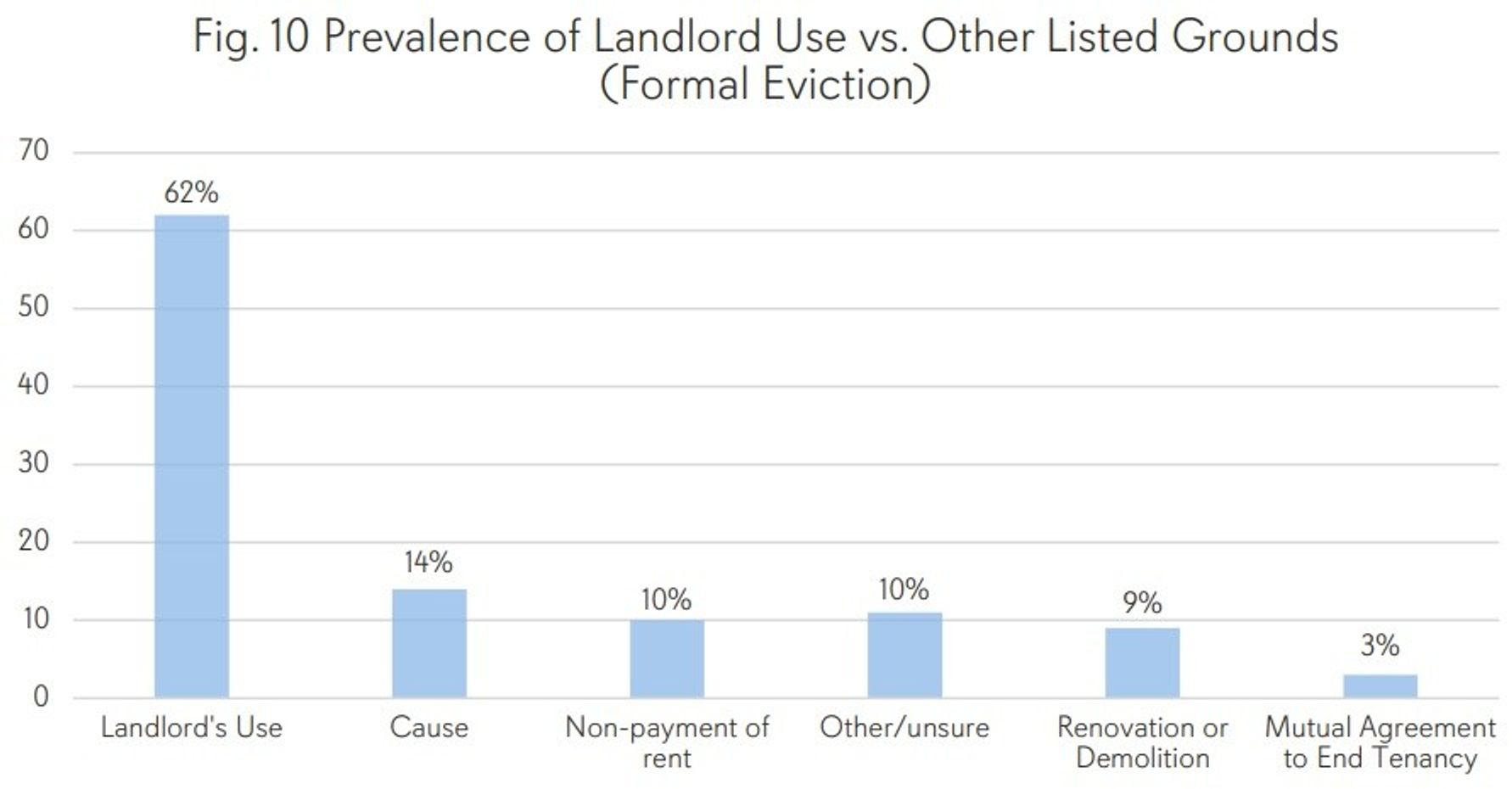
A bar graph comparing the listed grounds for formal evictions.
  • Data regarding listed grounds for evictions in BC, from a First United study published in 2023.(First United)

The BCREA's concerns were echoed by the Canadian Mortgage Brokers Association of British Columbia (CMBA-BC), who published their own open letter to the Ministry of Housing earlier this month.

"In practical terms, most lenders allow for a 90-120-day rate hold period when approving mortgages for real estate purchasers," said the CMHA-BC. "Adding a four-month notice period to terminate tenancies complicates the mortgage approval process, potentially leading to funding denials or increased costs for purchasers. These changes will impact first-time homebuyers the most as these are the most typical buyers of previous rental properties."

The BCREA went on the explain that without mortgage default insurance, lenders typically require a minimum down payment of 20% for rental properties, which many first-time buyers may not be able to provide. Additionally, a requirement of default-insured mortgages is often vacant possession. That now takes longer because of the increase to four months, the BCREA says, and in effect, becomes a five-month period when including the eviction dispute period increase to 30 days.

"Combining a four-month eviction notice with a 30-day dispute notice produces an effective five-month period in which a buyer can't take possession of their new home," said the BCREA. "This is impractical for buyers moving from one home to another and is too long a period to wait between completions."

Additionally, the BCREA also voiced concerns regarding the new Landlord Use Web Portal, saying that "older-generation landlords may not know how to use these sophisticated 'portals' and that the additional hassle may push landlords to sell their rental properties."

They also voiced privacy concerns as it relates to buyers.

"The portal will require landlords to provide details about the persons moving into the home. The details of the new occupant of the home will be shared with the tenant. Apparently, this includes sharing a copy of the Contract of Purchase and Sale, which includes personal and confidential information about the buyer which was never intended to be accessed outside of the transaction. Inappropriate use of this and any other private information by a former tenant could compromise the future safety of the buyer, especially if the former tenant blames the buyer for evicting them. The buyer's financial security could also be compromised."

Industry Recommendations

In light of these concerns, the BCREA recommended five changes: adjusting the rules for conventional mortgage buyers to allow for vacant possession within three months, allowing high-ratio insured buyers who will be occupying the property to continue to have a two-month notice period, adding privacy protections, allowing a paper-based alternative to the Landlord Use Web Portal, and eliminating the reporting requirement for buyers who intended to occupy their own unit.

"We are being told by REALTORS®, mortgage brokers, and clients that the increasing regulatory burden and cost is making rental property owners question whether they will be staying in the business," said the BCREA. "Increasingly, they are choosing to sell either to institutional owners who increase rents to better meet costs of operation. Or they are selling to those who would redevelop older properties, and likely eliminate the more affordable units."

"Our research indicates that owners of tenanted properties are finding it harder to sell these units, because of the regulatory load and costs imposed on landlords," they added. "There are many units that are being left vacant rather than having a tenant living there. This is even true for new condo units that are reaching completion. They are much easier to sell as vacant units so tenants are not getting the benefit of these coming onto the market. It is only recently that this kind of calculation has come into play in terms of owners' decisions to sell. This is hardly conducive to increasing the stock of rental units in the marketplace."

"We firmly believe that the amendments to the RTA will exacerbate the housing shortage in our province by discouraging investment and hindering entry into the market for first-time homebuyers," added the CMBA-BC. "Specifically, extending the notice period required to terminate tenancies will reduce incentives for property owners to make their units available for long-term occupancy. This restriction not only limits housing options but also poses challenges for financial institutions that play a crucial role in facilitating homeownership for British Columbians."

https://www.bcrea.bc.ca/wp-content/uploads/2024-07-RTA-Letter-to-Government.pdf

Read

Mortgage rates are now lower than a year ago, but house hunters remain cautious.

Couple has money problems

© South_agency - E+/Getty Images

Mortgage rates have been holding mostly steady this month, after dropping nearly a half percent from their peak earlier this year, Freddie Mac reports. “Despite these lower rates, buyers continue to pause, as reflected in tumbling new and existing home sales data,” says Sam Khater, Freddie Mac’s chief economist.

The National Association of REALTORS® reported this week that existing-home sales in June fell 5.4% compared to a year earlier. New-home sales also fell, down 7.4% compared to a year ago and the lowest pace since November 2023. 

“Many potential buyers are remaining in a holding pattern due to elevated mortgage rates that averaged near 7% in June,” says Carl Harris, chairman of the National Association of Home Builders. “However, moderating inflation suggests lower interest rates in the months ahead and that should bring more buyers off the sidelines.”

That could help home buyers handle the higher home prices, with existing-home prices surging to an all-time high in June, reading a median of $426,900. At this week’s average 30-year fixed mortgage rate of 6.78%, with a 20% down payment, a household would face a monthly mortgage payment on a median-priced existing home of $2,222, says Jessica Lautz, NAR’s deputy chief economist. Housing affordability and still-high inflation remain pressing issues holding many would-be home buyers back.

Indeed, real estate agents in the Mid-Atlantic region report that affordability was the main reason their clients paused their home search over the past six months, with about half citing high prices, not enough homes in their price range, or high mortgage rates.

“With mortgage rates hovering around 7% and home prices continuing to rise, financing is a growing challenge for buyers, and this is beginning to impact a buyer’s ability to make it across the finish line,” says Lisa Sturtevant, Bright MLS’s chief economist. Bright MLS data shows that a rising percentage of sellers—14%, as of June—had a contract fall through due to the buyer’s inability to secure financing.

Mortgage Rates This Week

Freddie Mac reports the following national averages with mortgage rates for the week ending July 25:

  • 30-year fixed-rate mortgages: averaged 6.78%, slightly higher than last week’s 6.77% average. A year ago, 30-year rates averaged 6.81%.

  • 15-year fixed-rate mortgages: averaged 6.07%, rising slightly from last week’s 6.05% average. A year ago, 15-year rates averaged 6.11%.

Read

For the second time in a row, Canada’s central bank has cut its overnight lending rate. 

In its pre-scheduled July 2024 announcement, the Bank of Canada dropped the target for the overnight lending rate by 25 basis points to 4.50%. 

While inflation remains above the Bank’s 2% target, it is expected that inflation will continue to ease as the global economy expands into 2026, bolstering the Bank’s decision to continue lowering rates. 

In his opening remarks to reporters at a press conference following the announcement, Tiff Macklem, Governor of the Bank of Canada, cited that the risk that inflation continues to grow must be balanced against the risk that the economy and inflation could weaken.

“Looking ahead, we expect inflation to moderate further, though progress over the next year will likely be uneven. This forecast reflects the opposing forces affecting inflation. The overall weakness in the economy is pulling inflation down. At the same time, price pressures in shelter and some other services are holding inflation up,” said Macklem. “We are increasingly confident that the ingredients to bring inflation back to target are in place. But the push-pull of these opposing forces means the decline in inflation will likely be gradual, and there could be setbacks along the way.” 

What does a second rate cut mean for homebuyers?

Despite the highly-anticipated rate cut made in June — the first drop to the overnight lending rate in four years — the slight decrease to lending rates last month did not encourage as many homebuyers back to the market as expected. However, with a second consecutive rate cut now in the books, a 50 basis-point-drop to lending rates may coax more homeowner hopefuls to reignite their purchase plans. 

According to a recent Royal LePage survey, conducted by Leger,1 51% of Canadians who put their home buying plans on hold the last two years said they would return to the market when the Bank of Canada reduced its key lending rate. Eighteen percent said they would wait for a cut of 50 to 100 basis points, and 23% said they’d need to see a cut of more than 100 basis points before considering resuming their search.

“Our research shows that many buyer hopefuls have been waiting for a concrete signal from the Bank of Canada that the economy is moving in the right direction. A second cut to the overnight lending rate indicates just that, and with mortgage qualification thresholds continuing to come down, sidelined buyers may have the confidence they need to make their return to the housing market,” said Karen Yolevski, COO of Royal LePage Real Estate Services Ltd. 

“We expect this will prompt a slight boost in activity in the short-term, followed by more robust buyer demand in the fall. In the meantime, some much-needed inventory has been building in major markets over the last few months, giving buyers more options to choose from. In addition to lower rates, this may also encourage more buyers to re-enter the market in the near future.”

The Bank of Canada will make its next announcement on Wednesday, September 4th. 

Read the full July 24th report here.

Read

📞 Your Next Step Starts Here—Contact Me Today!

Tara Kennedy
REALTOR® ABR, RENE, SRS
✨ Tara Kennedy Real Estate 🏘️
☎️ 236-992-8989
🌐 TaraKennedy.ca
📧 TaraKennedySells@gmail.com
🇨🇦 Royal LePage ELITE West

Always Putting Your Best Interest First! 🌟

#TaraKennedyRealEstate #TaraKennedyRealtor #TricitiesRealEstate #CoquitlamRealtor #PortMoodyRealEstate #PortCoquitlamHomes #RoyalLePageEliteWest #BCRealtor #HouseHuntingBC #BuySellInvest #HomeSweetHome #DreamHomeFinder #RealEstateExpert #MoveToBC #RealtorSince2007 #TaraKennedyHomes #TricitiesRealtor #YourTricitiesRealtor #GreaterVancouverRealEstate #InvestInRealEstate #SellingHomes #BuyingHomes #LuxuryRealEstate #RoyalLePageRealtor #TaraKennedySellsHomes

Read

Market recovery in Canada will be moderate and somewhat unpredictable over the next few years

Author of the article:

Murtaza Haider and Stephen Moranis

Published Jul 17, 2024  •  Last updated 1 day ago  •  3 minute read

Join the conversation

The housing market in Canada has slowed because people who would be buying homes now purchased them during the pandemic to take advantage of ultra-low interest rates. PHOTO BY POSTMEDIA

The Canadian Real Estate Association (CREA) is the most data-rich entity in Canada, monitoring housing sales and prices. CREA has revised its latest housing market forecast, lowering its expectations for sales and price appreciation.

Earlier in April, CREA was hopeful of a resurgence in markets because of the anticipated interest rate cuts. Those hopes have since been tempered by the latest sales data, along with consumer surveys confirming the lack of buyer response.

In early June, the Bank of Canada reduced its prime rate by 25 basis points. However, this initial rate cut, coming as it did after 10 successive rate hikes, was insufficient to persuade sidelined buyers to re-enter the housing market. While additional rate cuts are anticipated, uncertainty around their magnitude and timing continues to contribute to market instability.

CREA projects that 472,395 homes will be sold through the Canadian MLS Systems in 2024. Although this forecast represents a six per cent increase from last year’s volume, it falls short of earlier projections. Furthermore, the anticipated transactions for 2024 remain below the long-term trend, as indicated by the 10-year moving average. The moderate sales growth forecasts extend into next year, as CREA estimates 501,902 sales in 2025.

On the surface, CREA’s forecasts might suggest a struggling market. However, if one excludes the COVID-19-induced housing frenzy from the equation, the sales volume in 2024 and 2025 would align with the longer-term average sales volume.

In other words, the pandemic-driven sales surge distorted the market, mainly due to the phenomenon of forward buying — whereby consumers accelerate their purchases to take advantage of time-limited incentives, such as significant discounts or low interest rates. By 2019, an average of 500,000 dwellings were bought and sold annually through the MLS system. However, the drastic interest rate cuts in 2020 and 2021 led to a significant acceleration in sales, adding an estimated 238,000 transactions that most likely would not have otherwise occurred.

Dr. Dogan Tirtiroglu, a professor of real estate at the Ted Rogers School of Management at Toronto Metropolitan University, explains that housing is a durable good. The heightened homebuying in 2020 and 2021 partially exhausted the demand from a relatively finite pool of prospective buyers. Consequently, the anticipated rate cuts may not significantly boost sales, as many of those who would have purchased homes in 2023 or later had already done so in 2020 and 2021 to take advantage of the ultra-low mortgage rates.

Despite CREA’s reduced sales forecasts, by the end of 2025, there will still be an additional 188,865 transactions in the system, driven by the ultra-low mortgage rates of 2020 and 2021. This indicates that the recent slowdown in sales has not been enough to counterbalance the surge in transactions from those years.

Since there is finite demand for homebuying and homeownership within a given period, excessive purchasing in an earlier period can depress sales in subsequent ones, even with a growing population of potential buyers. This phenomenon partially explains the current slowdown relative to the peak activity observed during the early pandemic years.

While sales activity shows volatility, housing prices tend to be more stable. CREA reported that average house prices in 2023 decreased by 3.6 per cent. Forecasts for 2024 show an annual increase of 2.5 per cent, followed by a further increase of five per cent in 2025.

Regional differences in price appreciation are linked to changes in demand driven by economic recovery levels. Housing prices in Alberta are expected to grow by nearly eight per cent annually this year and next. In contrast, relatively modest price gains are forecasted for Ontario, Canada’s largest provincial housing market.

The uncertainty surrounding the timing and magnitude of future interest rate changes, coupled with the finite capacity for homebuying within specific intervals, suggests that the housing market recovery in Canada will be moderate and somewhat unpredictable. Significant short-term fluctuations in either direction are unlikely.

📞 Your Next Step Starts Here—Contact Me Today!

Tara Kennedy
REALTOR® ABR, RENE, SRS
✨ Tara Kennedy Real Estate 🏘️
☎️ 236-992-8989
🌐 TaraKennedy.ca
📧 TaraKennedySells@gmail.com
🇨🇦 Royal LePage ELITE West

Always Putting Your Best Interest First! 🌟

#TaraKennedyRealEstate #TaraKennedyRealtor #TricitiesRealEstate #CoquitlamRealtor #PortMoodyRealEstate #PortCoquitlamHomes #RoyalLePageEliteWest #BCRealtor #HouseHuntingBC #BuySellInvest #HomeSweetHome #DreamHomeFinder #RealEstateExpert #MoveToBC #RealtorSince2007 #TaraKennedyHomes #TricitiesRealtor #YourTricitiesRealtor #GreaterVancouverRealEstate #InvestInRealEstate #SellingHomes #BuyingHomes #LuxuryRealEstate #RoyalLePageRealtor #TaraKennedySellsHomes

Read

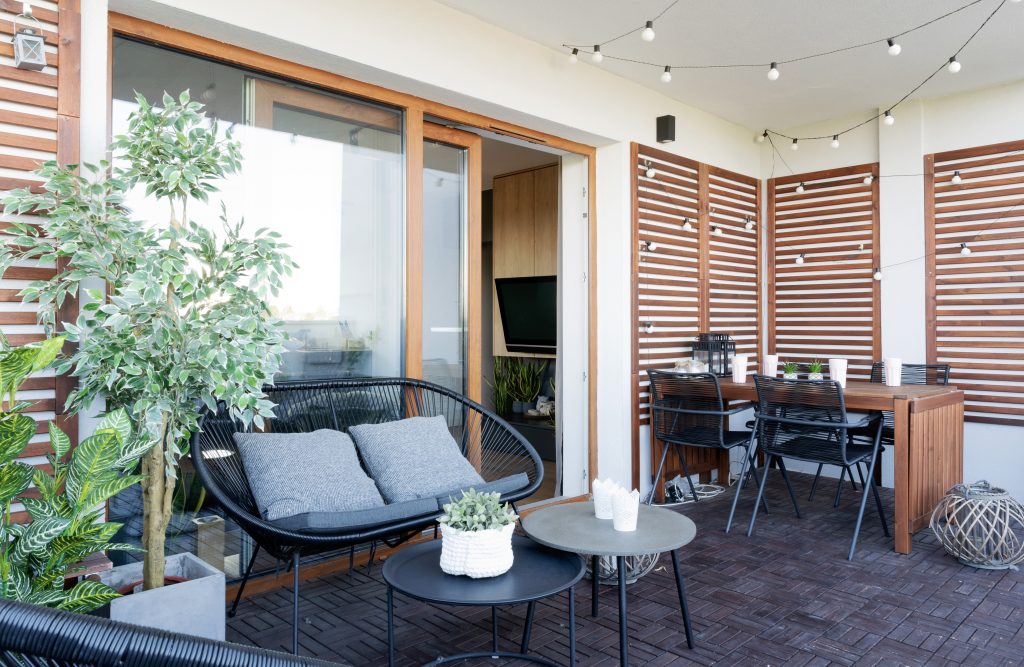
A modern patio with outdoor sofa and dining area

Don’t let a small outdoor space cramp your style – there are plenty of ways to create a usable,yet charming, oasis in even the smallest of outdoor spaces.

Apartment living has become the norm in many urban cities. This has opened up a new opportunity for retailers to capitalize on the need for practical solutions for small outdoor spaces. This is great news for anyone looking for compact patio furniture, as there are now plenty of options to choose from that go beyond the classic bistro set.

We’ve put together a list of our five favourite essential considerations to help you transform your compact outdoor space into a comfortable, stylish, and functional retreat, all while staying within your budget.

1. Comfort

You don’t need to compromise on comfort just because you don’t have a sprawling outdoor space. Uncramp your compact condo balcony or the like with comfortable, cozy furniture and fixtures.

Ambient lighting adds a welcoming warmth to any space. Lanterns and string lights are a popular choice because they’re relatively inexpensive and easy to find. You can also install pot lights or pendant lights if your space allows.

Consider battery-operated or solar powered lighting if electrical outlets aren’t available, and play it safe with LED candles inside of open-flame lanterns.

2. Privacy

Oftentimes when you live in an apartment or a unit with a smaller outdoor space, you’re confronted with a lack of privacy. Without a fence or wall between you and your neighbour, no matter how well you get along, sitting outside to relax or entertain can feel awkward and uncomfortable.

If you find yourself in a situation where you’d prefer to feel less like you’re in a fishbowl and more like you’re in your own garden getaway, you can use privacy screens, room dividers, vertical gardens or outdoor curtains to add more privacy to your outdoor space.

3. Style

It used to be common to see a balcony minimally furnished with a simple bistro set and perhaps a few items stored in plain view. Now, with all of the patio furniture lines created specifically for homes with limited outdoor square footage, it’s easier to find pieces that match your personal style.

A simple way to bring colour and texture into the space is with pillows and comfy throws. Don’t let the walls go to waste either – hang artwork, plants and signage. Lighting not only adds to the ambiance but can also lend itself as a décor piece – explore different sizes, styles and colours that suit your outdoor area.

Lastly, an important but overlooked area of the balcony or patio is the floor. To enhance your balcony’s style, invest in an outdoor rug or carpeting for colour and comfort, faux wood panels for a stylish deck-like appearance, or paint or stain concrete floors to match your unique aesthetic.

4. Durability

Style is important, but so is functionality. Luckily, there are many pieces of furniture and décor that were made to withstand the elements. 

When choosing outdoor furniture, look for sets made from aluminum, teak, stainless steel, or weather-resistant wicker. These materials are best able to tolerate the Canadian climate. Investing in high-quality and weather-resistant furniture is an excellent idea, especially if you don’t plan on storing it indoors during the winter months. Higher-end vendors pride themselves on the quality of their products, and have gone to great lengths to ensure the furniture you purchase will not rust, and the fabric won’t fade.

You can also choose to have built-in benches installed that will not only provide ample seating, but also plenty of storage for your outdoor entertaining items and textiles.

5. Budget

When choosing budget-friendly outdoor furnishings, look for items made of durable materials . To save on costs, you want to avoid needing to replace your items every few years due to deterioration.

If you keep your eye out, you can probably find furniture and other outdoor décor second-hand on online marketplaces or at thrift stores. You can also repurpose items you already have to use in your outdoor space, and simply bring it back indoors to store it in the winter if it’s something that can’t handle the cold.

From cozy furniture to innovative lighting solutions, there are endless opportunities to create a comfortable and functional balcony or patio. Happy decorating!

📞 Your Next Step Starts Here—Contact Me Today!

Tara Kennedy
REALTOR® ABR, RENE, SRS
✨ Tara Kennedy Real Estate 🏘️
☎️ 236-992-8989
🌐 TaraKennedy.ca
📧 TaraKennedySells@gmail.com
🇨🇦 Royal LePage ELITE West

Always Putting Your Best Interest First! 🌟

#TaraKennedyRealEstate #TaraKennedyRealtor #TricitiesRealEstate #CoquitlamRealtor #PortMoodyRealEstate #PortCoquitlamHomes #RoyalLePageEliteWest #BCRealtor #HouseHuntingBC #BuySellInvest #HomeSweetHome #DreamHomeFinder #RealEstateExpert #MoveToBC #RealtorSince2007 #TaraKennedyHomes #TricitiesRealtor #YourTricitiesRealtor #GreaterVancouverRealEstate #InvestInRealEstate #SellingHomes #BuyingHomes #LuxuryRealEstate #RoyalLePageRealtor #TaraKennedySellsHomes

Read
Reciprocity Logo The data relating to real estate on this website comes in part from the MLS® Reciprocity program of either the Greater Vancouver REALTORS® (GVR), the Fraser Valley Real Estate Board (FVREB) or the Chilliwack and District Real Estate Board (CADREB). Real estate listings held by participating real estate firms are marked with the MLS® logo and detailed information about the listing includes the name of the listing agent. This representation is based in whole or part on data generated by either the GVR, the FVREB or the CADREB which assumes no responsibility for its accuracy. The materials contained on this page may not be reproduced without the express written consent of either the GVR, the FVREB or the CADREB.